Theory of Change

Making Sanctuaries in a
Time Between Worlds

Theory of Change — At a Glance

Our theory of change unfolds through five interconnected movements — from understanding the predicament we are in, to the educational response it requires, and the larger civilizational horizon we hope to serve.

1. The Predicament—Where are we?

The metacrisis is not a collection of isolated problems, but a deeper civilizational predicament rooted in the systems, relationships, and ways of understanding reality that shape modern life.

↓
2. The Problem—What are we responding to?

Beneath it lies a crisis of human formation: we lack the orientation, aspiration, developmental pathways, communal capacities, and formative environments capable of preparing us to appropriately navigate and respond to these times.

↓
3. The Developmental Hypothesis—What does this moment require?

Transformation of this depth requires long-term human and communal formation, bringing spiritual depth, relational maturity, systemic intelligence, developmental practice, decolonial thought, and ecological belonging into a coherent developmental path.

↓
4. The Response—What are we building?

A wisdom-centered educational architecture, rooted in the Global South, bringing transformative education, transdisciplinary research, ecosystem weaving, and cultural imagination into a coherent developmental ecology serving a new generation of post-activist leaders and world-builders seeking to organize their lives toward meaningful participation in what comes next.

↓
5. A Civilizational Horizon—What larger possibility are we serving?

We hope to contribute to the emergence of cultures, institutions and communities where wisdom becomes a central organizing function and collective life is increasingly oriented toward the flourishing of all life.

↓

Select any section to explore it in greater depth.

1. The Predicament

Understanding The Metacrisis

“The metacrisis is the historically specific threat to truth, beauty, and goodness caused by our persistent misunderstanding, misvaluing, and misappropriating of reality.”
— Jonathan Rowson

Humanity is living through a time of profound civilizational rupture.

In 1993 Edgar Morin and Anne Brigitte Kern introduced the term polycrisis1

For a brief introduction to the polycrisis, see:

Global Polycrisis as a Pathway for Economic Transition - by Zack Bush for the United Nations Development Programme.

For a good technical introduction, see:

Lawrence, M., Homer-Dixon, T., Janzwood, S., Rockström, J., Renn, O., & Donges, J. F.

“Global Polycrisis: The Causal Mechanisms of Crisis Entanglement.”, Cascade Institute, 2024.
, describing the complex entanglement of interwoven crises facing humanity, arguing that the true vital problem was not one single issue, but the interconnected mesh of all crises on Earth. More recently, during the 2023 World Economic Forum's annual gathering in Davos, the concept has entered mainstream discourse as institutions and communities struggle to make sense of an increasingly unstable world. While the reality of the polycrisis has been more widely acknowledged and has helped illuminate the interconnected nature of our challenges, we believe it does not fully explain the deeper roots generating them. Beneath the interconnected visible crises of our time lies what some have called the metacrisis.2

The metacrisis understands the interconnectedness of our global collective crises—ecological collapse, social fragmentation, institutional breakdown, technological risk, and meaning crisis—as symptoms of deeper, underlying conditions and patterns generating them. The metacrisis is a crisis at the “meta” layers of civilization, it's a dysfunction in the underlying ways of perceiving, relating, and understanding reality that modern civilization has been built upon. These patterns have become profoundly embedded in our institutions and systems, creating self-destructive feedback loops driving a set of new, unique and escalating anthropocentric existential and catastrophic risks3

For more, see:

Schmachtenberger, Daniel. “Catastrophic and Existential Risk,” 2017. Civilization Emerging.
The Consilience Project. “Challenges to Making Sense of the 21st Century,” 2021. The Consilience Project.
Morton, Timothy. Hyperobjects: Philosophy and Ecology after the End of the World. 2013. University of Minnesota Press.
Bostrom, Nick, and Milan M. Ćirković, eds. Global Catastrophic Risks. 2008. Oxford University Press.
, and also in our perception, shaping how reality becomes intelligible to us: what we value, how we relate, and what kinds of futures we are capable of imagining.

It is, therefore, a crisis not only of systems, but of being.

It points to the crisis unfolding:

• within ourselves, in our psyche, soul and spirit;

• between ourselves, in the ways we relate to one another and life itself; and

• beyond ourselves, in the worldviews, ontologies and civilizational narratives that shape how reality becomes meaningful and intelligible to us.4

In the same way that a symptom points to an underlying disease that is causing it, the polycrisis is pointing to the metacrisis as the deeper civilizational patterns and dysfunctions driving our global challenges.

We understand the metacrisis as unfolding across three interconnected layers5:

Layer 1

The Symptomatic Layer

The Polycrisis

Ecological Collapse
Climate Destabilization
Social Fragmentation
Geopolitical Conflicts
Forced Displacement
Economic Inequality
Institutional Distrust
Mental Health Pandemic
Genocide/Ethnocide
Etc...
Layer 2

The Structural Layer

Meta-Systemic Dysfunctions

Power Asymmetries & Reinforcing Feedback Loops

Increasing concentration of capital and capability within an ever-smaller set of hyper-agents (states, corporations, or individuals) whose scale then lets them further tilt the system’s rules in their favour.

Suggested resources

These references indicate sources of learning and inspiration.

Perverse Incentive Structures

Systems that reward short-term, rivalrous, and harmful behaviors, while punishing those who refuse to abide by it, making them competitively disadvantaged and pressured until driven out.

Adversarial Sensemaking Networks

Information ecologies that are fragmented and adversarial, undermining our capacity for collective sensemaking, discernment of truth, trust and coordination.

Suggested resources

These references indicate sources of learning and inspiration.

Narrow Metric Optimization & Lack of Responsibility for Externalities

The systematic optimization of simplistic metrics predating upon the complex living ecosystem and web of relationships we all depend on. Negative externalities generated by individuals, corporations or governments are transferred to others, to the future or to the planet, while benefits are internalized by a few.

Suggested resources

These references indicate sources of learning and inspiration.

Rivalrous Dynamics x Exponential tech = Death of humanity

Suggested resource

These references indicate sources of learning and inspiration.

Layer 3

The Spiritual-Ontological Layer

Foundational Dysfunctions

Crisis of Perception

Persistent delusions of separation between self and other, humans and the world, misapprehending nature and reality.

Crisis of Denial

The denial of systemic violence and our complicity in harm. Our tendencies to search for ”hope” in simplistic solutions and to turn away from difficult, painful work.

Suggested resources

These references indicate sources of learning and inspiration.

Crisis of Relationship

The pervasiveness of rilvarous dynamics and the loss of intimate relationships with all life: ourselves, others, the world and the sacred.

Suggested resources

These references indicate sources of learning and inspiration.

Crisis of Value

The loss of connection with the sacred and a generalized confusion over what's really valuable, culminating in a loss of meaning and the abandonment of an orientation towards the good, truth and beautiful.

Crisis of Capacity

Individuals are not developing the emotional, relational, spiritual and intellectual maturity at the same rate that our technologies are increasing in power and consequence.

Suggested resources

These references indicate sources of learning and inspiration.

Global Intimacy Disorder x Exponential tech = Death of our humanity

Suggested resource

These references indicate sources of learning and inspiration.

So, if one were to summarize the dynamics underlying the metacrisis, we could say:

A collapse in our shared capacity to perceive reality as intrinsically valuable and to make decisions accordingly
×
Rivalrous dynamics x Exponential technology
×
Systems that reward externalizing harm onto the commons and the future
=
The Metacrisis

At its core, the metacrisis reveals a widening gap between the complexity and power of the world humanity has created and the depth of wisdom required to navigate it responsibly - and design accordingly. This is known as the growing wisdom gap.6

Wisdom Gap

Introduced by Tristan Harris from the Center for Humane Technology in this short video. We believe understanding these metacrisis dynamics is essential because the depth of our response must correspond to the depth of the predicament itself.

If the roots of the crisis are ontological, relational, developmental and spiritual, then responses focused solely at the level of symptoms or systems will remain insufficient. The challenge before us, therefore, is not only to redesign systems and institutions, but to increase our capacity for care, consideration and skillful action.

It is to transform the very ways of seeing, being, knowing and acting that gave rise to those systems in the first place. To be capable of perceiving interdependence, holding complexity, relating responsibly, and participating in life without generating conditions that undermine the future.

In other words, to become more wise.

2. The Problem We're Tackling

A Crisis of Education, Formation, and Communal Development

“If education is not the answer, you are asking the wrong question: why it's time to see planetary crises as a species-wide learning opportunity.”
— Zak Stein

The three layers of the metacrisis outlined above reveal a deeper educational and developmental crisis unfolding beneath our global challenges. The metacrisis is present not only at the levels of systems, institutions, and planetary conditions, but also in how human beings are being formed within them: how we learn to perceive, relate, desire, make meaning, exercise power, and understand what our lives are ultimately in service of.

If the metacrisis is simultaneously systemic, ontological, relational, developmental, and civilizational, then our educational responses must be capable of engaging these multiple layers of reality as well.

We understand this crisis of education and human formation through six interconnected gaps that together define the central problems our work seeks to respond to.

1. The Orientation Gap

What is worth offering our lives to?

+

Education rarely helps people engage seriously with the existential, ethical, spiritual, and ontological questions that orient a life. It develops intelligence and capability without sufficient clarity about what those capacities are ultimately in service of.

Read more

Modern education has largely withdrawn from the existential, spiritual, ethical, and ontological questions that belong at the heart of human formation: What is a human life for? What is the nature of reality? What is worthy of our devotion? What does it mean to live a meaningful life? How should we relate to suffering? What is ultimately worth serving?

These questions have often been relegated to religious institutions or the private sphere, leaving few serious educational spaces in which they can be encountered, practiced, and lived into. Yet education is never truly neutral. Every educational system carries implicit assumptions about what a human being is, what constitutes a good life, what is worthy of devotion, and what the world is for.

When these assumptions remain unconscious and unquestioned, the intelligence, capacities, and power cultivated through education can just as easily deepen fragmentation, alienation, and the destruction of life instead of contributing to its flourishing.

The problem is not only how human beings develop, but what their development is ultimately oriented toward.

2. The Aspiration Gap

Who must we become?

+

Human beings grow toward the horizons they can imagine. The images our culture offers — the achiever, the founder, even the changemaker — are too small for the depth of transformation this moment requires, and we have almost nothing higher to grow toward.

Read more

Human beings grow toward the horizons of possibility they are able to imagine. We are formed not only by what we are taught, but by the images of human possibility our cultures teach us to admire and aspire toward.

Many of the dominant aspirations of modern life remain organized around individual achievement, status, accumulation, productivity, recognition, and success. Even the figure of the “changemaker” can leave unquestioned the deeper existential questions and forms of maturation, responsibility, and transformation demanded by a civilizational crisis.

At a moment asking so much of humanity, the images of human possibility available to us feel too small for the depth of transformation required. We lack widely shared images of mature, wise, and responsible human beings capable of awakening deeper aspiration toward wisdom, courage, compassion, ethical discernment, and a life of devotion towards the flourishing of all living beings.

Without compelling images of who we must become, sacred dimensions of human potential can remain dormant, and with them, the more beautiful possibilities for the kinds of worlds those human beings might help bring into being.

3. The Formation Gap

How do we become such humans?

+

Education has become highly effective at expanding what people know, while neglecting the deeper formation of who they are becoming. We can accumulate knowledge without allowing it to transform our character, relationships, actions, or ways of life. Wisdom, responsibility, ethical discernment, relational maturity, and spiritual depth still remain largely peripheral to most educational projects.

Read more

Education has increasingly been reduced to learning, while neglecting the deeper work of human formation.

Much of conventional education continues to shape millions of people through models centered on standardization, information transfer, specialization, testing, credentials, and preparation for participation in the dominant economic and social systems. These forms of education have contributed to great scientific, technological, and material achievements — though their benefits have been unevenly shared, and they emerged within civilizational paradigms that have also generated profound costs for human communities and the more-than-human world.

These forms of learning matter. But learning is not the same as development, and development is not the same as formation. Learning expands what we know and can do. Development expands the capacities through which we perceive, make meaning, relate, and respond. Formation shapes who we are becoming, what we come to love, value, attend to, serve, and ultimately organize our lives around.

Modern education has been far less intentional about this deeper work. And the reason is that we are formed by how we engage with and meet reality, and education has taught us to meet it almost entirely through abstraction and analysis. It rarely engages the interior life, the relational field between people, the felt sense of belonging to a place, or the dimensions of existence that exceed explanation altogether.

This is why education can inform people well and form them hardly at all, because conceptual understanding alone can't fully transform a person. It is possible to understand interdependence completely and live extractively. It is possible to know the science of collapse and feel nothing. This is what happens when reality is only ever met from one depth.

In this sense, more education is not necessarily better. Forms of education that reproduce narrow-boundary thinking, competition, fragmentation, extraction, hyper-individualism, and disconnection from life may continue to strengthen the very patterns generating the metacrisis.

And as our technological and institutional power expands, the imbalance grows more consequential. We are rapidly increasing what human beings know and can do without cultivating, at anything like the same pace, the maturity to discern what is worth doing at all.

4. The Integration Gap

What containers sustain such becoming across time?

+

Many pieces of transformative education already exist — contemplative, ecological, systemic, relational, ancestral — but they remain fragmented, short-term, and disconnected from one another. We lack coherent pathways that hold them together across years, through practice, training and accompaniment, until transformation becomes a way of life.

Read more

We currently possess many pieces of alternative and transformative education offering the capacities and formation needed at this moment, but rarely the long-term container capable of bringing them together across time.

In response to the limitations of conventional education, powerful alternatives have emerged: ecological education, holistic education, contemplative practice, systems thinking, developmental frameworks, relational practice, community-based learning, ancestral and Indigenous ways of knowing, and new approaches to leadership and social transformation. Together, they offer essential contributions toward reimagining human formation for our time.

Yet they often remain fragmented from one another, delivered through short-term programs, disconnected from the wider structures through which people actually organize their lives, and structurally dependent upon the same civilizational logics they seek to transform. Few educational environments are capable of engaging the systemic, relational, ontological, developmental, ecological, and civilizational dimensions of our predicament in an integrated way.

The problem is not simply a lack of transformative experiences, but the absence of coherent pathways of formation capable of bringing these experiences into relationships across time. Profound transformation requires developmental ecologies in which different dimensions of growth can deepen, inform one another, become embodied through sustained practice and community, and eventually take root as a way of life.

5. The Communal Development Gap

How do we mature together?

+

Human development is still treated primarily as an individual endeavor, even though many capacities required by the metacrisis can only be cultivated together. Communities themselves must become the unit of development, not support structures for individual growth, but bodies capable of perceiving, sensing and acting as one - without suppressing individuality, difference and uniqueness.

Read more

We have treated human development primarily as an individual endeavor. Much of modern education — including many transformative and alternative approaches — continues to take the individual as its primary unit of change. We design curricula for individual learning, measure individual outcomes, cultivate individual capacities, and imagine transformation largely as something that happens within a person.

Yet many of the capacities required to respond to the metacrisis cannot exist within an individual alone. They can only be developed together. The challenge before us is not only to cultivate wiser, more courageous, and responsible individuals, but to learn how communities themselves can become subjects of development — collective bodies capable of deepening their shared attention, relational maturity, collective intelligence, capacity for sensemaking, and ability to act coherently in service of something larger than themselves.

This resonates deeply with Thich Nhat Hanh's vision that “the next Buddha will be a sangha.” The wisdom required to navigate planetary challenges cannot depend upon isolated individuals becoming exceptional enough to carry this responsibility alone. We need educational cultures in which the locus of development expands from the individual to the relational and communal.

And perhaps this widening must go further still. The communities within which we learn and develop are not exclusively human. A truly planetary education must restore our capacity to learn with and from the more-than-human world, recognizing land, ecosystems, other species, and living systems not merely as objects of knowledge, but as participants in the larger web of relationships through which human formation becomes possible.

6. The Civilizational Gap

What kinds of worlds cultivate rather than undermine our becoming?

+

Education does not end in schools: cultures, economies, technologies, institutions, and social environments continually shape who we become. Without transforming these wider societal infrastructures, people are repeatedly pulled back into the very patterns they are trying to outgrow.

Read more

At the deepest layer, we cannot respond to the metacrisis if education is reduced merely to schools, universities, or alternative institutions. Education, in its deepest sense, is the intergenerational process through which societies reproduce ways of perceiving, relating, knowing, valuing, and being across time.

Human beings are always being formed through culture, media, technology, economics, architecture, religion, family systems, institutions, and the wider social worlds they inhabit.

Civilization is always educating us and shaping the kind of humans we become:

  • Systems shape behavior.
  • Cultures shape perception.
  • The media shapes desire.
  • Institutions shape identity.
  • Economies shape relationships.
  • Technologies shape attention.

Many of the dominant systems of modern life reinforce acceleration, competition, extraction, fragmentation, hyper-individualism, and disconnection from the living world. Even people who sincerely long to live differently are continually returned to environments whose incentives, rhythms, and assumptions pull them back toward the patterns they are trying to transform.

Therefore, fragmented systems cultivate fragmented human beings, who then recreate fragmented systems. This recursive cycle has become one of the central dynamics perpetuating the metacrisis itself.

The task is not only to create better schools, programs, or institutions, though this is indeed necessary. We cannot expect that individuals will heroically resist the environments around them. Eventually, the communities, institutions, economies, technologies, and cultures themselves must begin to support different ways of being human.

3. The Developmental Hypothesis

What This Moment Requires

“The way we respond to the crisis is part of the crisis.”
— Bayo Akomolafe

The metacrisis cannot be adequately responded to with new technologies, policies, or institutions alone. The underlying ways of seeing, being, knowing, and relating that continue to generate and reproduce the metacrisis cannot, by themselves, create the conditions for a life-enhancing civilization to emerge.

Many of the dominant structures of modern civilization — educational systems, media environments, economies, technologies, and cultural norms — continually shape our desires, identities, ambitions, and behaviors in ways that reinforce fragmentation, extraction, hyper-individualism, disconnection from life, and an inability to fully perceive our interdependence with living systems.

We believe this moment calls for profound human and civilizational transformation in how we understand ourselves, reality, and our relationship with all life.

We understand this moment as a civilizational rite of passage: a threshold asking humanity to mature beyond many of the ways of being that modernity has normalized. This means cultivating forms of wisdom, relational maturity, ethical depth, strategic capacity, ontological grounding, and collective coordination capable of opening new possibilities for how we live, relate, and act together — reducing the existential risks before us while helping create the conditions for a radically more life-affirming civilization to emerge.

This level of civilizational maturity may be something unprecedented for us — not because these capacities themselves are new, but because of how broadly they are now needed, how deeply they must be integrated, and the scale of complexity and power they are being asked to hold.

Wisdom traditions have cultivated compassion, ethical discernment, spiritual depth, and relational maturity for millennia, often through long-term pathways of practice, community, discipline, and devotion. Our time asks that such capacities are now brought into relationship with other forms of intelligence needed to navigate planetary complexity: systemic intelligence alongside spiritual depth; technological capability alongside ethical discernment; individual agency alongside relational maturity; strategic thinking alongside ecological belonging; and human flourishing understood as inseparable from the flourishing of the wider living world.

Our developmental hypothesis is that capacities of this depth cannot be cultivated through information transfer, isolated workshops, or short-term transformative experiences alone. They require long-term formation: sustained practice and training, mentorship, relationship, community, meaningful responsibility, reflection, and opportunities to participate directly in the challenges of our time. Over years, these conditions can help cultivate the kinds of human beings and communities capable of navigating this moment with greater wisdom, maturity, and responsibility.

And this formation cannot remain individual. Our current challenges are too complex for a single person to make sense of it. We need to gain the capacity for collective discernment, shared attention, trust, distributed intelligence, and coordinated action that only emerge between people and through communities. Our developmental environments must be capable of cultivating not only wiser individuals, but communities that can learn, mature, discern, and act together in service of something larger than themselves.

We call these environments developmental ecologies: interconnected constellations of practices, relationships, training, communities, mentors, experiences, rituals, forms of inquiry, and pathways of responsibility capable of supporting the long arc of human and communal maturation.

Over time, developmental ecologies can become developmental cultures — ways of living in which wisdom, responsibility, relationship, and maturation become embedded in the norms and practices of collective life.

We call this a developmental hypothesis because it remains an inquiry to be tested, challenged, and refined through practice. We do not presume to know exactly what forms of human and collective development will be adequate to the transformations ahead. But we see growing evidence that better solutions alone are insufficient when the people, relationships, and environments implementing them continue to reproduce the patterns they seek to transform.

4. The Response

Building Wisdom-Centered Educational Architectures

“That's what being an imaginal cell in the transition from caterpillar to butterfly really means. It means taking some empowered responsibility for being someone who recognizes that you can't just run the instruction manual that was given historically, and the new instruction manual doesn't exist yet. It's actually the time of people in that liminal phase to work on developing what are these new structures.”
— Daniel Schmachtenberger

A Lineage

Historically, at moments of civilizational rupture, oppression and cultural transition, new forms of education and communities have emerged at the edges of society to help individuals navigate transition, protect different ways of being, and envision radically different futures. Monasteries, folk schools, mystery schools, Terreiros, quilombos, wisdom traditions and indigenous communities such as the Zapatistas created developmental environments capable of cultivating the ontologies, capacities, relationships, and cultural coherence required for their time, and not fully supported by the dominant world around them.

We understand our work as part of this longer lineage of experimentation, and we are drawing inspiration from them to build something our moment highly needs and largely lacks.

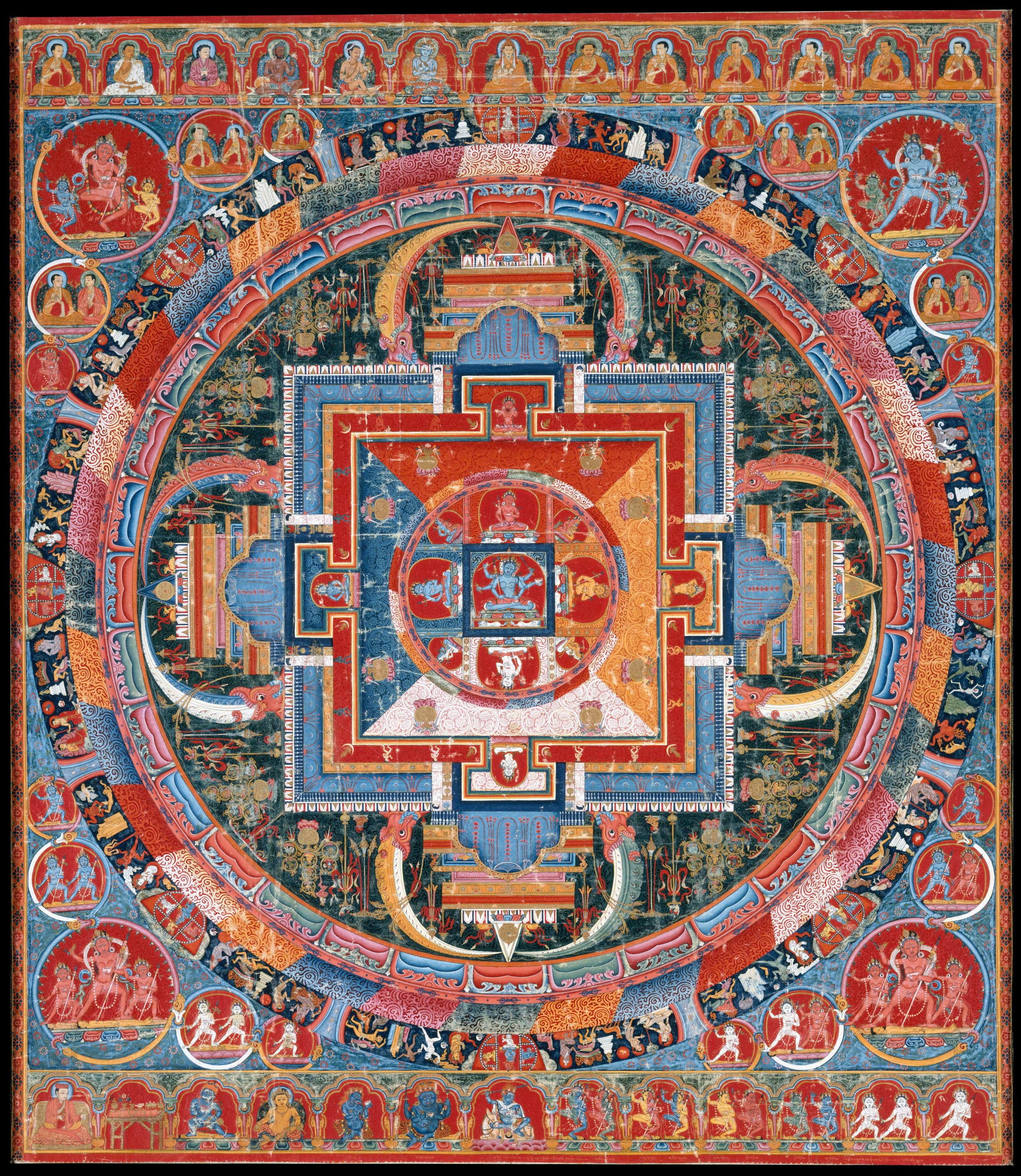
A Buddhist lineage mandala of Jnanadakini, 14th century Tibetan painting

What We Are Building

A wisdom-centered educational architecture and developmental ecosystem, rooted in the Global South, capable of supporting the long arc of human and communal transformation required during a time between worlds.

We are initially focused on serving a new generation of emerging leaders — post-activists artists, educators, thinkers, organizers, researchers, change-makers and world-builders — who feel the crises of our time deeply in their souls, long to organize their lives around meaningful participation in what comes next, yet struggle to find communities and developmental pathways capable of holding the magnitude of their aspiration, grief, and devotion.

In this sense, our work is not only a response to the metacrisis, but also to the many young people who experience themselves as living without a world at this moment. Not fully belonging to the world that is ending, while not completely inhabiting the one trying to be born.

Rather than creating another isolated program, we are experimenting with a multi-decade developmental pathway capable of meeting the depth of transformation this moment requires. We are bringing together spiritual practice, systems understanding, relational formation, ecological belonging, decolonial thought, mentorship, community, and meaningful opportunities to contribute to life-enhancing futures into a coherent ecology of becoming.

In doing so, we seek to address deeper crises of perception, relationship, value, and capacity while bringing metacrisis awareness into generative relationships with wisdom traditions, contemporary developmental approaches, and the lived knowledge of historically marginalized communities in the Global South.

Our work supports the construction of wisdom-centered educational architectures capable of shifting our ways of perceiving, being, knowing and doing, through four mutually reinforcing dimensions:

1. Transformative Educational Lab

1. Transformative Educational Lab

Education for the end of the world as we know it

The living laboratory where our educational architecture is tested, refined, and deepened.

Through retreats, residencies, courses, immersive programs, rituals and transformational practice — developed in-house and with fellow educators — we prototype the containers, cultures, and pedagogies capable of forming people and communities with the ontologies, aspirations, and capacities this moment asks for.

Learn More
2. Research & Inquiry

2. Research & Inquiry

Investigating the questions shaping our world

Through transdisciplinary research, original essays, collaborative thinking, social cartographies, and curated collections, we investigate civilizational questions shaping our time: what brought us here, what is happening now, who we must become, and what is trying to emerge.

These inquiries not only contribute to the wider cultural narrative building, sensemaking and collective coherence that can better orient wiser action in a time of uncertainty, but they directly inform the ideas, curriculum, and practices of our own educational architecture.

Learn More
3. Ecosystem Integration

3. Ecosystem Integration

Tending to the emerging fabric of a wisdom-centered culture

We map, integrate and connect initiatives, practices, communities, and institutions responding to different dimensions of the metacrisis. By making this ecosystem more visible, comprehensive and relational:

  1. 1. We help isolated communities, initiatives and institutions to find one another.
  2. 2. We connect members of our community with new pathways for their life and organizations doing meaningful work in the world.
  3. 3. We integrate multiple educational initiatives, practices and forms of formation into our educational architecture, supporting more robust and coherent developmental journeys.
Learn More
4. Artistic & Cultural Interventions

4. Artistic & Cultural Interventions

Expanding what our culture can perceive and imagine

We collaborate with artists and cultural practitioners to give form to emerging ways of seeing, being, and imagining life beyond the dominant paradigm. Through stories, images, music, rituals, and cultural artifacts, we seek to convey the depth of this crisis, the transformation it asks of us, and the horizons worth orienting towards, in ways that touch the heart and soul of our culture.

Making life-enhancing futures not only intellectually understandable, but emotionally and imaginatively available.

Learn More(soon)

We see these four dimensions as mutually reinforcing parts of a single ecology. Research and inquiry deepen the hypothesis and ideas of our educational architecture and pedagogy; educational experimentation generates new insights, questions and practices; ecosystem relationships expand the teachers, mentors, training and pathways available to our community; and artistic work carries emerging ideas and imaginaries into the wider culture.

Together, they form the foundation for an ongoing experiment in what wisdom-centered education and human formation might become.

Experimental by Design

While our work emerges in response to a global metacrisis, it is intentionally contextual and place-based — rooted in Brazil and the Global South, and initially focused on the formation of younger generations in the region. Over time, we hope to deepen the intergenerational dimension of this work, bringing younger and older generations into closer relationships and restoring forms of intergenerational responsibility, mentorship, and care that our culture has forgotten.

We are fundamentally trying to cultivate some of the conditions from which a wiser civilization might emerge: developmental environments, pedagogies, relationships, communities, resources, and pathways of responsibility capable of forming people and communities who can perceive more deeply, make sense of complexity, coordinate across difference, and act together with greater wisdom.

People committed to helping reduce the existential risks before us, hospice what can no longer serve life, and participate in building the institutions, cultures, and infrastructures from which more life-affirming futures might take root.

Our work is therefore experimental by design, and we understand ourselves as one node within a much larger constellation of communities around the world engaged in related inquiries. We do not presume to know what forms of education will be adequate for the century ahead, nor what the future itself will demand of us.

But this moment is calling for bold experimentation in education, community, governance, economics, and collective action — experiments that can help us learn our way toward what comes next. And this is our attempt to contribute to that.

5. A Civilizational Horizon

Cultivating Wisdom-Centered Civilizations in Service of Life

“I think you should dream the Earth, because she has a heart and she breathes.”
— Davi Kopenawa

Our larger aspiration extends beyond the formation of wiser individuals and communities. We are interested in what might become possible if wisdom cultivation itself became a more central function of culture, supported not only by spiritual, religious or educational spaces, but by a growing ecology of institutions capable of cultivating relational maturity, responsibility, and care for life across generations and species.

We use the language wisdom-centered civilization not as a blueprint for what the future should become, nor as a single worldview to be imposed upon it, but as a horizon we are orienting toward. Forms of collective life in which growing human power is accompanied by growing wisdom; human flourishing is understood as inseparable from the flourishing of all life; and institutions take seriously their responsibility in shaping the desires, aspirations, attention, relationships, and ways of living of our culture.

Over time, we hope to contribute to the emergence of a wisdom-centered civilizational ecology of initiatives and communities across Brazil and beyond, experimenting with radically different ways of organizing collective life, including:

  • Modern monasteries, wisdom schools, and intentional communities devoted to long-term human formation, rites of passage, intergenerational learning, and service to life.

  • Autonomous and bioregional communities preserving ancestral ways of being while experimenting with collective ownership, commons, ecological stewardship, and new forms of governance.

  • Transformational and developmental institutions cultivating new practices for shifts in consciousness, desire, relationship, and capacity in service of building different systems, not merely adapting people to the existing one.

  • Research institutes, cultural laboratories, and artistic movements generating paradigm-shifting ideas, narratives, and imaginaries capable of expanding what societies perceive as possible.

  • Post-capitalist economic experiments organized around sufficiency, reciprocity, gifting, regeneration, and shared flourishing rather than accumulation and shareholder return.

  • New forms of governance and justice designed to distribute power, repair harm, and include future generations and the more-than-human world in collective decision-making.

  • Life-affirming technologies and infrastructures designed to deepen attention, relationship, collective agency, and human flourishing rather than extraction, addiction, and control.

What connects these initiatives and communities is a different civilizational orientation, where they place the deepest questions of existence related to meaning, value, reality, and ultimate concern back at the heart of collective life.

What is a human life for? What is worth committing a life to? What should we protect? What does it mean to live a meaningful life? What is the nature of reality we participate in? What does it mean to love?

These questions are not left as optional concerns, but become central for how we organize power, resources, relationships, technology, and our participation in the living world.

We do not know what future civilization will look like, nor do we believe any single organization, tradition, or culture has the answer for our predicament. What we hope to help cultivate are the human, communal, cultural, and institutional conditions from which a mature, wise, and life-affirming form of civilization becomes possible.

Towards Collective Coordination in Service of the Flourishing of All Life

Built with v0